Published April 30, 2026 · ~15 min read
What Happened?
On April 19, 2026, Vercel — the cloud platform behind Next.js and used by millions of developers worldwide — disclosed a major security incident. Unauthorized actors had gained access to internal Vercel systems, compromising environment variables, API keys, and tokens belonging to an unknown number of customers.
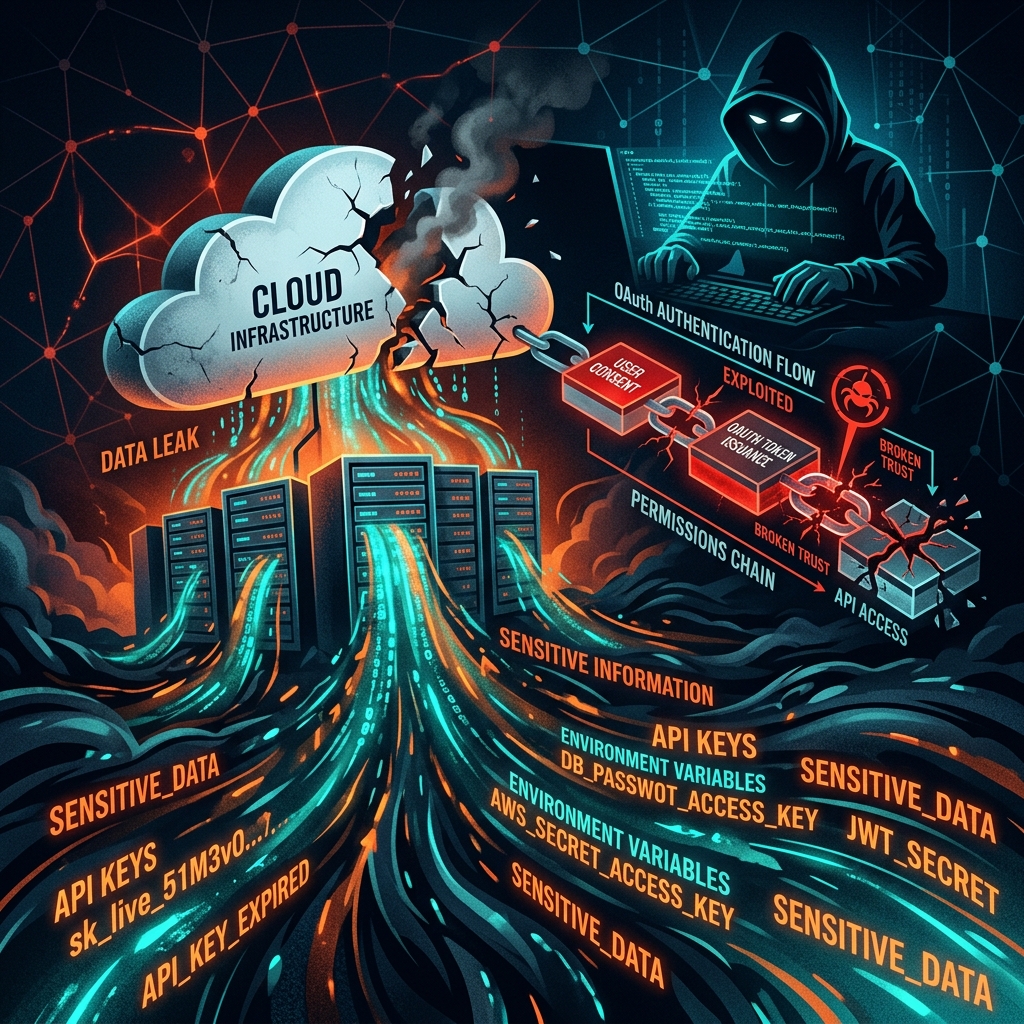
The breach wasn't the result of a sophisticated zero-day exploit or a brute-force attack on Vercel's infrastructure. Instead, it was a textbook supply chain attack — one that exploited the weakest link in modern cloud security: third-party OAuth permissions.
The Kill Chain: How the Breach Unfolded
The attack followed a precise, multi-stage kill chain:
- Step 1 — Compromise Context.ai: The attackers first compromised Context.ai, a third-party AI analytics tool used by developers to monitor LLM performance. The exact method of compromise hasn't been disclosed, but it gave attackers control over Context.ai's backend systems.
- Step 2 — Exploit OAuth Tokens: A Vercel employee had connected their corporate Google Workspace account to Context.ai, granting it broad OAuth read permissions. When Context.ai was compromised, the attackers inherited these permissions — essentially gaining a valid, trusted session into the employee's Google Workspace.
- Step 3 — Lateral Movement: From the Google Workspace foothold, the attackers pivoted into Vercel's internal systems. They were able to enumerate and access environment variables across customer projects — but only those that were not explicitly marked as "sensitive" within Vercel's platform.
- Step 4 — Data Exfiltration: A threat actor associated with the name "ShinyHunters" — a well-known cybercriminal group — claimed responsibility and listed the stolen data on a hacker forum with a $2 million asking price.
What Was Exposed?
The breach specifically targeted environment variables — the configuration values that power modern applications:
- Database connection strings (PostgreSQL, MongoDB, Redis URLs with credentials)
- Third-party API keys (Stripe, Twilio, SendGrid, AWS access keys)
- JWT secrets and session tokens
- Internal service URLs and webhook endpoints
- SMTP credentials and email service configurations
Critically, variables that customers had explicitly marked as "sensitive" within Vercel's dashboard were encrypted at rest and remained protected. This distinction saved many organizations from catastrophic exposure — but highlighted a dangerous default: most developers never mark their variables as sensitive.
Why This Breach Matters
This wasn't just another data breach. It exposed fundamental weaknesses in how the modern developer ecosystem operates:
1. The OAuth Permissions Epidemic
OAuth is the backbone of modern SaaS integration — "Sign in with Google," "Connect your GitHub," "Grant access to Slack." But every OAuth grant is a trust extension. When you grant an app access to your Google Workspace, you're essentially saying: "I trust this app's security as much as I trust Google's."
The Vercel breach proves this trust is misplaced. Context.ai was a legitimate, well-regarded tool. But it became the weakest link — and one employee's OAuth grant became the doorway to an enterprise breach.
2. Environment Variables Are the New Crown Jewels
Developers routinely store database passwords, API keys, and secrets in environment variables. It's considered best practice compared to hardcoding secrets in source code. But the Vercel breach shows that env vars are only as secure as the platform storing them — and the permissions governing who can read them.
3. "Sensitive" Marking Is Security-by-Opt-In
Vercel's "sensitive" variable feature — which encrypts values at rest and hides them from the dashboard — is excellent when used. But it's opt-in, not opt-out. The default behavior is that environment variables are stored in plaintext. This is a classic example of insecure defaults.
Vercel's Response
To their credit, Vercel responded with transparency and speed:
- Engaged Mandiant (Google's premier incident response firm) for forensic investigation
- Notified law enforcement immediately
- Contacted affected customers directly with specific remediation guidance
- Confirmed that Next.js, Turbopack, AI SDK, and npm packages were NOT tampered with — the supply chain remained intact
- Published a security bulletin with recommended actions
Immediate Actions If You Use Vercel
If you deploy on Vercel, take these steps today:
- Rotate ALL environment variables — Every API key, database password, JWT secret, and token. Assume they're compromised until proven otherwise.
- Mark all variables as "Sensitive" — Go to your Vercel project settings and toggle every environment variable to sensitive. This encrypts them at rest.
- Audit OAuth permissions — Review every third-party app connected to your Google Workspace, GitHub, and Vercel accounts. Revoke anything you don't actively need.
- Enable MFA everywhere — Multi-factor authentication on Vercel, Google Workspace, GitHub, and every connected service. Use authenticator apps, not SMS.
- Review deployment logs — Check for any unexpected deployments, configuration changes, or new team members added in the last 30 days.
- Monitor for credential abuse — Set up alerts on your cloud providers (AWS CloudTrail, GCP Audit Logs) for unusual API activity from your leaked keys.
Lessons for Every Developer and Organization
Whether you use Vercel or not, this breach teaches universal lessons:
- Principle of Least Privilege: Never grant an app more permissions than it needs. If an AI tool only needs to read chat logs, don't give it full Workspace access.
- Secrets Management: Use dedicated secrets managers (HashiCorp Vault, AWS Secrets Manager, Doppler) instead of relying on platform-native env vars as your only secret store.
- Vendor Security Assessment: Before connecting any third-party tool, assess its security posture. Check for SOC 2 compliance, penetration test reports, and incident response plans.
- Zero Trust Everything: Treat every integration point — API, OAuth, webhook — as a potential attack surface. Verify continuously, trust nothing by default.
- Regular Credential Rotation: Rotate secrets on a schedule, not just after incidents. Automate rotation wherever possible.
The Broader Pattern
The Vercel breach follows a troubling trend in 2025-2026: attackers are increasingly targeting the tools developers trust rather than the infrastructure they build. From the Codecov supply chain attack to the CircleCI breach to Context.ai — the pattern is clear. The development toolchain is the new attack surface.
As AI tools proliferate in developer workflows — code assistants, analytics platforms, automated testing — each one represents a new trust boundary that must be managed, audited, and secured.
"You're only as secure as the least-trusted tool in your pipeline. In 2026, that tool might be the AI assistant you forgot you connected three months ago."
At RudraVault, we help organizations identify these blind spots through comprehensive security assessments. The Vercel breach is a reminder that security isn't a feature — it's a practice.